I've had a few first viewings of movies recently, and I've had recent repeat vieweings of what, IMHO, were the best films of 2007 and 2008 respectively. Rather than write them all up separately, I'm going to take them all in one post. 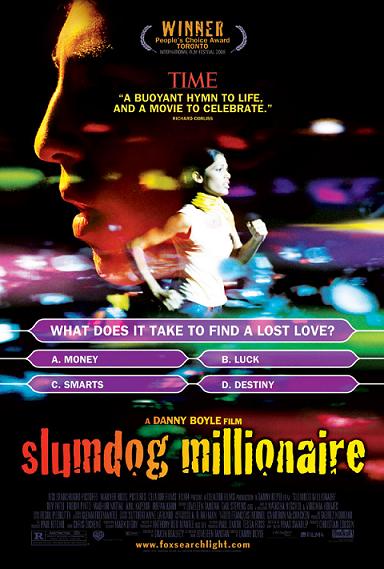
Slumdog Millionaire is, at its heart, a romantic drama. This made me shy away from it at first; I'm usually not keen on romantic pictures (though one could argue that Casablanca falls into that category, and I certainly dig that one). Also, I wondered whether the movie would ignore the reality of the slums from which the slumdog protagonist came. I'm not one to have my nose rubbed in injustice and inequality, but sugarcoating offends me.
My initial wariness about this film turned out to be unwarranted. Slumdog Millionaire brilliantly and boldly walks a fine line between pathos and fantasy as it tells the story of a boy and a girl who fell in love as children, lost each other, then found each other again after the boy found himself on India's version of Who Wants to be a Millionaire? The protagonists (Jamal Malik, his brother Salim, and their friend Latika) are Indian Muslims who are orphaned after a Hindu mob kills their mothers. Jamal (Dev Patel) falls for Latika (Frida Pinto), who is taken by a local gangster. Jamal rescues Latika, only to have her taken away and, presumably, raped by Salim, who murdered the gangster, and went to work for a second gangster. Jamal gets Latika's attention years later by getting himself on TV. He becomes a national hero as he answers questions correctly and Indians of all stripes make him the vehicle of their individual aspirations. In the end, boy gets girl and there's a fabulous production number at the main Mumbai train station.
The movie does not minimize poverty, violence, or injustice--or, for that matter, enhanced interrogation techniques--nor does it emphasize them to the point of preachiness. Kids grow up in slums all over the world; some get bitter and cynical and go outlaw (Salim); some work legally and hang on to their dreams (Jamal). And everybody roots for the underdog.
Slumdog Millionaire is a nice film to watch on BluRay. It is very colorful and vibrant, and some of the actors are attractive enough to want to see them in hi-def.
My DW is a big Dan Brown fan, so, as a matter of public record, I liked Angels and Demons a whole hell of a lot. That out of the way, it was a pretty average movie, and, like the film version of The Da Vinci Code, shows that some visual images that work in the imagination on the written page do not work particularly well on the silver screen. 

IMHO, There Will be Blood was the best film of 2007 and The Dark Knight was the best of 2008. I recently viewed both films for the first time since the Panic of Fall 2008. The last couple of scenes of There Will be Blood, in which a crazed, wealthy oilman self-destructs, now seems an apt metaphor for the end of an era of dangerously self-indulgent, unregulated market capitalism. The Joker's wild anarchy in The Dark Knight, driving the citizens of Gotham into a state of utter panic, doesn't really seem so far-fetched in light of the near-collapse of the financial markets and the the near-panic of the pig flu--and this after the movie raised provocative questions about privacy rights and the lengths to which a civilized society can go against malefactors before we become malefactors ourselves. One point that Hurricane Katrina, the Panic, Al Qaeda's insanity, and some elements of our reaction to terrorism have driven home to me is that the veneer of our open, law-bound, refined, wealthy civilization that we've spent centuries pasting on top of the Hobbesian state of nature is thinner than many of us would like to think. The Dark Knight makes this point without being didactic or obnoxious about it.
Wednesday, May 27, 2009
The Good, the Bad, and the Classic

Monday, January 26, 2009
Bizarro in Belgium
I was in an odd mood over the weekend, so I watched the weird, darkly comic In Bruges. The movie is about two Irish, London-based hitmen who are sent to Bruges to hide out and await further instructions. The mood is deceptively light at the outset, as Colin Farrell's character grudgingly follows Brendan Gleeson's character on a tour of a well preserved medieval city. The mood darkens when Farrell's character simultaneously unravels and falls in love. Farrell's undoing has to do with the consequences of his actions in a killing organization that has a moral code. Thus, the film ends as a sort of Catholic morality tale.
Astonishingly, Colin Farrell's acting holds this movie together. He is, by turn, witty, brutal, and vulnerable. He has a knack for comedy that I'd not seen before. Also, the guy can act when he wants to. Keep in mind that the characters in the movie are Irish, and they swear in an Irish fashion. The film may drop as many f-bombs as Scarface.. My impression from years of cussing and observing the cussing of others is that the f-bomb in Ireland is roughly equivalent to "damn" in the U.S. in terms of social acceptability. Whatever. I liked this bizarre, quirky film.
Sunday, December 07, 2008
Good Books
The TLS books-of-the-year edition is out. Alas, mine usually makes it here a couple of weeks late. I suspect that the print edition will have recommendations from many more reviewers than the online edition offers. I used the best books list to pick up a couple of excellent books last year; perhaps I'll do the same this year.
Or maybe I'll just wait for the next Stephanie Meyer vampire novel to come out. Confession--I've actually not read any of Meyer's books, though DW has, and three of them are in the bookcase on my side of the bed. We saw Twilight and Quantum of Solace on successive days last weekend. Surprisingly, I thought Twilight the better of the two. Love Daniel Craig as James Bond, but, man, Quantum is just plain dull.
Wednesday, October 01, 2008
Cinematic Justice
I just ordered the newly restored BluRay version of The Godfather trilogy. The previous DVD version was a total piece of junk, so I'm looking forward to seeing the two masterpiece films of that series in all their glory. The studio powers-that-be hired the restorationist who fixed Lawrence of Arabia, and the restored version of that film is stunning. It should be a fun little film festival at my house when the package arrives.
Monday, August 25, 2008
The Moviegoers
DW and I had an opportunity to play Politeness Man yesterday at the local cineplex, during a viewing of the movie about another superhero, Bat Man. Perhaps 30 minutes into the film, the ball cap-wearing philistine two seats over received, and responded to, a text message, shining his cell screen and making clicky noises. I said nothing, assuming that a theater employee would catch him next time around. After all, this theater previously had been a tad militant about its no-cell policy.
Sadly, the theater appears to have accepted the cellular decline of Western civilization, and such militant enforcement is no longer the case. With about 15 or 20 minutes left in the film, the cap-wearing philistine Cellular Man received a telephone call and began to engage in a conversation, no doubt concerning the purchase of whatever controlled substance he planned to use after the movie. "Get off the phone!" I shouted at him, to no avail. DW went to the lobby to summon help from theater employees, who were milling about, no doubt daydreaming about what they would do with that oily gunk to which the motion picture industry refers as "butter." I can only imagine the depraved horrors that go on in that den of celluloid atrocities. John Waters might learn a thing or two from the gunky daydreams I imagine these folks were having. I'm just saying.
Oh yes, back to our story. DW returned with a theater employee, who sat next to the cell phone scofflaw, spoke with him for a few seconds, then got up and left. Cellular Man and his wife placed their feet on their knees and refused to allow DW to pass through to her seat (one gets the feeling that these vile people have done this before). I looked underneath DW's seat and could not ascertain whether she had taken her purse with her, or I would have gathered her up and left the premises. I also worked through the mental calculations of whether it would be worth it to engage in a brawl inside the cineplex. Just then, DW summoned a theater employee, who returned with her, told the Cellular People to allow DW through, then disappeared instantaneously. Cellular Woman let her through, but Cellular Man attempted to trip her before letting her pass. A negligence action against the theater might have been an interesting prospect had DW fallen, but I'm glad she made it back to her seat. As the credits rolled, I shouted, "leave your damn phone home, next time, [expletive deleted]!" This all happened in a half-full theater, and nobody else had a thing to say about it. The Cellular People verbally accosted us in the lobby. DW made a point of loudly telling Cellular Woman not to try and intimidate her, which had the effect of shooing them of. The management provided us with movie passes, and I fired off an irate e-mail to corporate headquarters when we arrived home.
I think that if the cell-phone prohibition is dropped, then I should be allowed to blurt out snarky remarks and spoilers during movies. That is how some people used to watch movies in New Orleans, after all, which could make bad movies very fun.
Saturday, July 19, 2008
Holy Psycho Anarcho-Nihilist, Batman!
We saw The Dark Knight this afternoon. We had been looking forward to viewing the film at the local IMAX, but that crummy theater closed its IMAX permanently just in the nick of time. Christopher Nolan actually filmed parts of the film with IMAX cameras, so this film must be particularly sweet on the right screen. I thought about driving to Houston, but the IMAX there is sold out for all features this weekend. Oh well.
All the hoo-haw about Heath Ledger's performance in this movie is justified. His Joker isn't just a gangster in a goofy get-up, but a cynical anarchist and a nihilist who engages in antisocial behavior because he likes to watch the chaos he creates. Ledger looks and sounds wonderfully creepy, though a funny, brainy kind of creepy. The Joker also comes close to seducing Batman out of his job, and the wanted superhero is susceptible to that kind of seduction. Their cat-and-mouse game is wonderfully played by Ledger and Christian Bale. Heath Ledger's performance might land him the Oscar he should have won for Brokeback Mountain.
Monday, May 19, 2008
HDTV--the ultimate revelation?
I love Howard Beale's sermon in Network about the power of television, even as I love watching my selected shows--that season finale of The Office was great, and I can't wait for season two of Pushing Daisies. Network is one of my favorite movies, and it was downright prophetic about the blending of news, commentary, and entertainment. It was somewhat less prophetic about the quality of programming generally; IMHO, the proliferation of cable channels has led to better, less formulaic programming across the board.
All that said, we got our HDTV receiver from Direct TV on Saturday, and the picture quality is astonishing. I watched a rerun of Top Chef just to marvel at the resolution.
Tuesday, March 25, 2008
But what does it have to do with Yeats?

That is no country for old men. The young
In one another's arms, birds in the trees
---Those dying generations---at their song,
The salmon-falls, the mackerel-crowded seas,
Fish, flesh, or fowl commend all summer long
Whatever is begotten, born, and dies.
Caught in that sensual music all neglect
Monuments of unaging intellect.
An aged man is but a paltry thing,
A tattered coat upon a stick, unless
Soul clap its hands and sing, and louder sing
For every tatter in its mortal dress,
Nor is there singing school but studying
Monuments of its own magnificence;
And therefore I have sailed the seas and come
To the holy city of Byzantium.
O sages standing in God's holy fire
As in the gold mosaic of a wall,
Come from the holy fire, perne in a gyre,
And be the singing-masters of my soul.
Consume my heart away; sick with desire
And fastened to a dying animal
It knows not what it is; and gather me
Into the artifice of eternity.
Once out of nature I shall never take
My bodily form from any natural thing,
But such a form as Grecian goldsmiths make
Of hammered gold and gold enamelling
To keep a drowsy Emperor awake;
Or set upon a golden bough to sing
To lords and ladies of Byzantium
Of what is past, or passing, or to come.
William Butler Yeats, Sailing to Byzantium
So DW goes off to church on Sunday morning, and I sit down to watch the Oscar-winning No Country for Old Men. I, of course, was expecting a period piece about Yeats's trip from his homeland to the Continent to appreciate antiquities.

Instead, I get something coming from my own homeland of West Texas. This connection notwithstanding, I spent the entire film trying to figure out whether it was an adaptation of Yeats's poem or something else entirely. Sailing to El Paso would be more like it. I just couldn't figure it out.
I really liked this movie. The plot is nothing spectacular, and it would hard to divine some kind of deeper meaning from the film. But it is an excellent film nevertheless, if not quite the masterpiece that is There Will be Blood. A Texas ne'er-do-well (Josh Brolin) comes across some drug money and steals it, only to be chased through West Texas by a crazy hit man (Javier Bardem), who, in turn is chased by another hitman from his own organization (Woody Harrelson). The local sheriff (Tommy Lee Jones) is also chasing Brolin, mostly to save him from Bardem. Bardem deserves all of the praise he's been given; his character was frighteningly crazy and delciously creepy. Tommy Lee Jones didn't have as much screen time as I would have expected (or would have liked; I'd watch Tommy Lee Jones read the phone book), but his character is the old man who realizes that he is out of his element with archcriminals like Bardem's character on the loose. It really was no country for old men. The harsh storyline was matched by the harsh country of West Texas, much of which appears hot and lifeless. I, for one, liked the Sopranos-like ending, with the now-retired sheriff chatting away about nothing important. He isn't doing anything important, but he is alive.
Sunday, February 10, 2008
Instant American Classic
Holy crap! gentle readers, I saw There Will Be Blood last night. I've thought about it a little, and it may be one of the best movies I've ever seen.
There is very little blood and there an ocean of oil in the movie, so it could be that the title is an allusion to certain events in the Middle East, in which oil, religion, and violence are all whooshed up together, but that may be a stretch. If it is indeed a "message movie," that fact is so subtle that it shouldn't stop anyone from seeing the movie.
The film takes place in the New Mexico and California oil fields right around the beginning of the 20th Century. Like Citizen Kane,, the movie is about greed and paranoid, ruthless ambition. The greed, paranoia, and ambition here are served up with strong flavorings of rage and resentment. The protagonist and antagonist in the film are oilman Daniel Plainview (Daniel Day-Lewis) and dirt-poor preacher Eli Sunday (Paul Dano) of the Church of the Third Revelation. One online reviewer referred to Plainview's business and Sunday's church as the twin churches of greed, and, in the film, that's exactly what they are. Plainview and Sunday are very much alike, and their relationship in the movie is a cycle of provocation and vengeance. Throughout the film, each is able to see through the other, and it seems that they can see something of themselves in each other.
The movie opens with a sequence of oil drilling scenes, with several minutes of no dialogue at all. Men are in claustrophobic, dusty, narrow holes in the ground, almost as if they are both injuring the Earth and digging their own graves. Quite a metaphor there. With a few exceptions, the landscape is a parched, nearly lifeless desert, much as Daniel Plainview's soul. The movie was filmed near Marfa, Texas. I've always wanted to visit the Big Bend country.
Much has been made of Daniel Day-Lewis's performance, and it is great. However, I was very impressed with Paul Dano (Dwayne in Little Miss Sunshine), who carries his rage, ambition, and greed in a more tightly controlled and devious fashion than Day-Lewis does--and his sermons are absolutely fabulous. The hustling preacher was a fixture on the American frontier, and Dano does that character justice--as Plainview said after one of his sermons, "that was a goddamn hell of a show!"
There Will Be Blood is a great movie. The pacing is a bit slow for anybody expecting rapid action, and director Thomas Paul Anderson gets a bit artsy, but only momentarily. This is one of those movies that people will be watching 50 years from now, it's that good.
Wednesday, January 02, 2008
Happy Effing New Years
2008 started off with our neighbors blowing up fireworks to wretched excess, which we wouldn't have minded except that DW had lasik surgery last week and hadn't had a good night's sleep in days, which means that I hadn't had a good night's sleep in days either. Grrr! I was in a relatively bad mood when I got up yesterday morning.
So I was in a mood for a little light entertainment yesterday. I went to bed last night reading Milton's Paradise Lost, and, before that, viewed the delightfully fun Scarface. I'd not actually seen that film before, which is kinda odd given my attraction to violent movies. I avoided the movie due largely to its venerated status in the gansta subculture. I'm pretty much a snob about the whole gangster glorification of violence, which differs somehow from whatever buttons violent entertainment pushes in my own subconscious mind. I suppose the difference is that I don't view the characters in these films as role models to be emulated. Whatever. Anyhow, I picked up the "platinum edition" at WalMart yesterday, which includes a hilarious option of two running tickers at the bottom of the screen--one for "f-bombs" (over 200) and another for gunshots fired (2,049). I remember Scarface being very controversial in its day (1983), largely for the number of f-bombs and the extremely high level of violence.
"Say hello to my little friend."
Scarface originally was planned as a remake of a 1930s movie by the same name about Al Capone, but the film was reconceived in the wake of the Mariel Boatlift of 1980, a brilliant move that allowed screenwriter Oliver Stone and director Brian De Palma to make a film more relatable to audiences of the mid-1980s. De Palma later came out with The Untouchables, which was all about Capone and Elliot Ness. Scarface is about the rise and fall of Tony Montana (Al Pacino), a nobody from Cuba who ruthlessly works his way to the top of the cocaine business in South Florida. The movie is quite emphatic about how the American dream of wealth, power, attractive sexual partners, and wretched excess can end very badly, a la GoodFellas. Scarface, however, is much wilder than GoodFellas, perhaps because there was no organized crime tradition to reign in Tony Montana's crazier impulses. The director, writers, and actors were absolutely fearless, and, I would guess, knew that the critics and other cultural guardians of the day would vehemently denounce their film. It's a much better movie than I expected it to be, but it certainly isn't for everybody.
Tuesday, December 04, 2007
My daemon
I haven't seen The Golden Compass, and I probably won't. Nevertheless, I submitted information to determine my daemon--a sort of shape-shifting alter-ego. Let me know whether you think it fits.
Sunday, December 02, 2007
Myth, Fear, and Magic
My dreams are filled with Jungian archetypes, but none of them take the forms of mythical, fairy tale figures. Nor did I really ever have a developed sense of magic and wonderment when I was a child. DW, OTOH, has always had a love of the magical, wonderous, credulous side of childhood. Last night, we got around to watching Guillermo del Toro's brilliant Pan's Labyrinth on DVD. She totally got everything about the film, while I had to fill in some gaps by watching the director's explanation of the power of childhood mythology. This is a film about choice, disobedience, belief, and coming of age into a very nasty adult world. That the true-life side of the story was really part and parcel of the fairy tale was something I didn't figure out until the very end, when the two clearly come together. This is a great movie, one that may be viewed in my home as many times as GoodFellas or Network.
Of the movies I saw that were made in 2006, I'd have to put Pan's Labyrinth and Alfonso Cuaron's Children of Men atop even my beloved Martin Scorsese's The Departed and Little Miss Sunshine, a movie I still adore.
Monday, November 26, 2007
Old English in 3D & CGI

We were in need of some mindless entertainment yesterday, so we saw Beowulf in 3D at the local IMAX theater. The writing and acting are mediocre at best, but seeing the movie was great fun nevertheless. I don't usually give a hoot about special effects, but the effects in this movie are spectacular. Also, it was funny how they played with the scenery to keep Beowulf's private parts from being seen when he was nekkid. Check it out.
I wonder whether some classic films with great action and scenery could be retrofitted in 3D? I know, I know, it's not nice to mess with the artists' vision, and, heaven knows, Ted Turner's colorized versions of Miracle on 34th Street and Casablanca were abominations. But wouldn't, say, Lawrence of Arabia or Doctor Zhivago be fabulous in 3D?
Friday, July 13, 2007
Harry Potter, Part 5

DW and I saw the partly 3-D version of "Harry Potter and the Order of the Phoenix" last night at the local IMAX theater. It and "Harry Potter and the Prisoner of Azkhaban" are, IMHO, the best films of the lot thus far. Imelda Staunton was frighteningly good as Delores Umbridge, the Church Lady-like torturer of Hogwarts students. At one point, as her wall of cats meowed, I leaned over to DW and said, "she's catshit insane." Daniel Radcliffe (Harry) and Emma Watson (Hermione) are coming into their own as actors, Radcliffe in particular. Harry's nightmare scenes, and his reactions to them, were convincing, and the actor was rather dashing in his attire throughout the film. When Harry discussed his dreams with Dumbledore and how he worried about going bonkers, I said, "well, I think Harry and I should have a conversation about our dreams." Alas, it was a very quiet moment, and other people in the theater could hear me. Big deal. The 20 minutes of 3-D worked very well in this film, particularly on the huge IMAX screen. It's well worth the extra few bucks to see it on IMAX, if possible.
Speaking of dreams, mine have been so intense and personal lately that I haven't wanted to post them here. I get the feeling my subconscious is shouting at me about a number of things; I just need to figure out what they are and whether I can do something about them or just let things play out in the dreams themselves.
Yesterday was a crazy day. It was my telework day, and I had a shitload to get done. Our power cut out around 9:30 a.m., so I drove to the nearest P.J.'s coffeehouse to get myself reconnected. When the power came back on (around 1:00), I went back home, and . . . the phone line was dead! This meant that I couldn't connect to my VPN, so I had to work in my c-drive the rest of the day and risk being asked why I wasn't logged-in. I didn't get any calls from the office, so I suppose I was okay. In any event, I managed to get a full days' work in; alas, the case I thought would be easy to write up turned out to be rather messed-up.
Sunday, April 15, 2007
Dystopian dilemmas
With many predominantly Caucasian Western countries concerned about immigration, and European countries in particular concerned about their low birth rates, it seems logical that those two concerns would be brought together, first in a novel, then in a movie. I haven't read the book, but I saw the movie last night on DVD. "Children of Men" takes those issues to extremes--a world in which infertility and immigration are the only issues anyone cares much about. I suppose that there's an unspoken metaphor for First World countries becoming impotent and sterile when they close their borders, needing infusions of life from the Third World. I don't know that the metaphor really works precisely with the entire world infertile, so maybe I'm reading too much in. I don't know.
The movie opens with the death of the youngest person on Earth, an 18 year old. For an unknown reason, the world has became completely infertile in 2008-09. Why, exactly, is a source of some conversation in the movie. The movie ends with the first birth in 18 years, to an African woman who evidently is an illegal immigrant to Great Britain. A pro-immigration terrorist organization plans to smuggle the woman to an underground fertility organization. Our reluctant hero, Theo (Clive Owen) is shanghaied to assist the woman, and there are several post twists along the way.
My viewing of the movie was informed somewhat by a couple of things. First, I recalled reading about some recent research suggesting that my own childrens' disabilities may have beeen caused by genetic quirks that, in turn, may have been caused by environmental events. Moreover, many parents of autistic children believe that childhood vaccines either caused their childrens' disorders or triggered whatever genetic predisposition may have been there. So I suppose anything is possible. Fortunately, however, the only truly universal environmental phenomenon of which I'm aware is global warming, which doesn't appear to have any genetic consequences. Second, all aspects of modern civilization pretty much collapsed around here in August 2005; I was thinking a little about that as I watched the brutality of the government and the deplorable living conditions of the illegal aliens in the film. If you think it can't happen here, you could be wrong.
"Children of Men" raises questions about the environment and, more directly, about migrations of people from the Third World to the First. For me, the movie was more provocative and thought-provoking about the latter question than was "Babel." It also presents a society without hope for a meaningful future. There is even a suicide drug in the film. It made me reflect on what a gift life, and future generations, really are. "Babel" was somewhat more hopeful, anyway. This is a movie that you'll think about for a while after seeing it, whether or not you agree with its politics. The acting, directing, and writing are quite good, and the action moves along at a good clip. Much of the story is told in the background visuals, which is a great technique. Check it out.
Wednesday, March 21, 2007
Zodiac, or, The Truth--is it really worth it?
Have you ever been so obsessed with discovering the capital-t Truth that you can't leave it alone, no matter what the consequences may be? Then, just as you think you've finally discovered the Truth, it a) gets away from you; b) is too scary to take on directly; or c) really wasn't worth the damage cased by the process of getting to it. Moreover, as the New Yorker's David Denby pointed out, the real end of an obsession is the obsession itself, and not the end it is ostensibly aiming to achieve. Those themes and subthemes set David Fincher's "Zodiac" apart from other procedural crime dramas, and brought up questions about some of my own, personal quests for the proverbial holy grail.
There is shockingly little actual violence in "Zodiac," seeing as how it's a movie about a notorious serial killer, the Zodiac, who terrorized the San Francisco Bay area in the late 1960s and early 1970s. But I didn't miss the bloodied, mangled corpses. The drama in the movie occurs mostly inside the SFPD and the SF Chronicle newspaper, and, to a lesser extent, police departments in outlying areas. But the real drama occurs inside the heads of Chronicle cartoonist Robert Graysmith (Jake Gyllenhaal), SFPD Detective Dave Toschi (Mark Ruffalo), and, to a lesser extent, Chronicle reporter Paul Avery (Robert Downey, Jr.). Graysmith wouldn't let the unsolved case die after the police departements moved onto other things, and he wrote the two books on which the movie is based. The case is officially unsolved, though Graysmith put together a pretty strong circumstantial case against a particular guy who died in 1992. The SFPD deactivated its Zodiac investigation in 2004, so it looks as though we'll never really know for sure.
That's the factual account. Gyllenhaal is brilliant with the psychological material. His Graysmith character moves from a groupie, trying to worm his way into discussions of the letters that arrived at the newspaper offices, to a throroughly obsessed madman, with boxes of files in his house and charts hanging on the wall. His wife (played by the fabulous Chloe Sevigny of "Big Love") left him over his obsession, after he endangered his family by announcing his plan to write a book in the newspaper and on television, and after he got his children involved in Zodiac-related activities. He comes off more as a geeky, obsessed, self-absorbed nut than as a dedicated crusader for truth. Mark Ruffalo is a little more low-key as the kind of "I hate to admit it, but I'm almost as obsessed as he is" Detective Toschi. Ruffalo's performance was understated, I suppose so that Gyllenhaal's charater's nuttiness would stand out. However, Robert Downey, Jr., is still a scene-stealer, and he steals his scenes in this movie, as the flambuoyant, alcoholic reporter who wrote most of the early Zodiac stories.
This is a very good movie, and I wouldn't be surprised to see a few Oscar nominations coming out of it.
Sunday, March 04, 2007
Crummy Title; Good Movie
We saw the espionage drama "Breach" the other night, about FBI analyst Robert Hanssen, who spied for the Russians for 15 years or so of his 25-year FBI career. Hanssen led what must have been a tightly compartmentalized life--he was a fanatical Catholic, a mild sexual deviant, a counterintelligence wizard, and a traitor to his country. Those pieces don't fit together in any coherent fashion or form, and the movie makes no effort to explain the jarring incongruities in the man's life. In the end, it doesn't give any simple explanation as to why he took up spying for the former godless commies he denounced from his position as a devotee of the Opus Dei brand of Catholicism. DW said that there was a very simple explanation--he did it because he could. I suppose that's as good a reason as any, and, in real life, are there really simple explanations for many of our own inconsistencies and hypocricies?
Chris Cooper is awesome as the creepy Hanssen, and he plays all aspects of the character very convincingly. Ryan Phillippe is good as Eric O'Neill, the aspiring FBI analyst who was planted in Hanssen's make-work office; he was told that he was put there as part of an investigation into Hanssen's sexual deviancy. Only later was he told that his boss was suspected of treason. Laura Linney was kind of wasted as the head of the Hanssen investigation unit; a shame, as she is a good actress.
Saturday, February 24, 2007
World Movie

I watched "Babel" this morning, and, I must say, I found myself a little "meh" about the film. It's a good movie, but not a great one. The acting is excellent, and it is nice to see some of the best talent in other countries on the American screen. The idea of interconnected storylines in very different parts of the world is appealing, but it's damn hard to pull off convincingly, unless it's a James Bond movie, and those aren't exactly written to show the interconnectedness of all sentient beings. In "Babel," the point is that suffering and hope are universal phenomena. I found myself a little icked out by the Japanese girl looking for love in all the wrong places, and pretty unsympathetic to the undocumented alien nanny in California who took the kids to Mexico--after learning that their mother had been shot in Africa, if I got the timeline of the film right. Also, the link between the Japanese and African storylines was just a bit too tenuous for me.
If I a vote, I would probably pick "Little Miss Sunshine" as best motion picture of the year, with "The Departed" a very close second. As much as I love violent Scorsese films, LMS is fresh, quirky, and authentic. Interestingly, DW agrees with me on that. We frequently don't see eye to eye on our entertainment choices, and I didn't think she would like LMS. I haven't seen "The Queen" or "Letters from Iwo Jima," so I can't comment on them.
Saturday, February 10, 2007
Winning isn't everything; it's the only thing.
I saw the appalling reality-show trainwreck "Showbiz Moms and Dads" on A&E a year or two ago, so when I heard that there was a movie out involving a young girls' beauty pageant, I thought I would take a pass on it. This past Tuesday, I went to WalMart, eagerly anticipating the purchase of "The Departed" on DVD. However, I had my dates wrong, and "The Departed" isn't out until this coming Tuesday. I had seen that "Little Miss Sunshine" had won a few awards, and I actually got around to reading a very brief review of it, so I figured, "what the hell?" and picked it up.
The Hoover family in "Little Miss Sunshine" may be the quirkiest movie family since "What's Eating Gilbert Grape?" came out in the early 1990s. Unlike "Gilbert Grape," however, this movie doesn't hit so close to my own life as to make it difficult to watch. "Little Miss Sunshine" is a commentary on the obsession we have with being winners. I was expecting a light, fluffy comedy, but that's not what I got. It's slightly dark, actually, with the members of the family failing at one thing or another as the movie rolls along. The beauty pageant at the end, however, is fabulously funny. The quirk factor of this movie is high, and I can see why it got an Oscar nomination for best picture.
Sunday, June 18, 2006
Killers with a conscience

We finally watched "Munich" last night. It is well worth a viewing. I can see why it was controversial in some cicles, but that happens with thought-provoking films. "Munich" is thought-provoking indeed. "How does a society best respond to terrorism?" is the central question of the movie, and Steven Spielberg and Tony Kushner don't answer that question. However, they do point out that violence can beget more violence in response, and that terrorists who are killed may be quickly replaced by people who may be even worse. Also, the members of the Israeli hit squad have deep ethical concerns about their activities, even as they kill the Black September leaders responsible for murdering the Israeli athletes at the Munich Olympics. As in "Team America, World Police," we see that people like us need people like them in the shadows to keep us safe from even worse people. But we sure as shootin' need to give some thought to the results we want to achieve and use these shadowy figures to achieve those ends. "Hell if I know" would be my answer to the question posed by the film, but it seems worth it to explore the question and the other questions to which it gives rise.

